
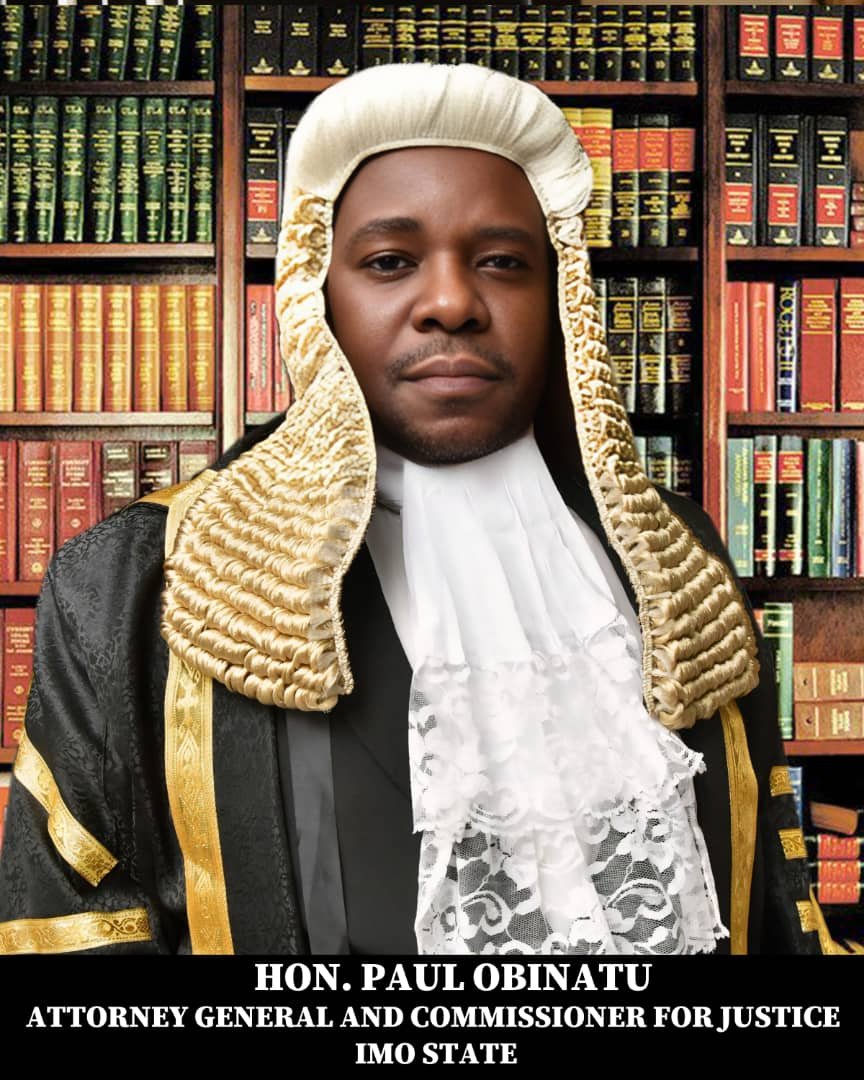
Imo State Attorney-General and Commissioner for Justice, Paul Obinatu, has accused the National Judicial Council (NJC) of exceeding its constitutional powers by allegedly directing the Imo State Judicial Service Commission (JSC) on who should be nominated as the state’s substantive Chief Judge.
In a statement issued on November 6, Obinatu argued that the NJC has no constitutional authority to dictate or substitute its preferred candidate for the independent assessment and recommendation of the Imo State JSC.
His reaction followed a directive reportedly issued by the NJC during its 112th meeting held on November 3 concerning the appointment of a substantive Chief Judge for Imo State.
The Attorney-General maintained that while the Constitution empowers the NJC to recommend a candidate to the governor, it does not give the council the power to determine the candidate the State Judicial Service Commission must submit for consideration.
He relied on Section 202 of the 1999 Constitution, as amended, which provides that the State Judicial Service Commission shall not be subject to the direction or control of any authority or person while carrying out its constitutional responsibilities.
Obinatu also cited Section 271(1) and relevant provisions of the Third Schedule to the Constitution, insisting that the State JSC is responsible for identifying and advising on suitable candidates, while the NJC’s role is limited to recommending one of the submitted candidates to the governor for appointment, subject to confirmation by the State House of Assembly.
He further argued that the NJC’s appointment guidelines cannot override the Constitution or be used to interfere with the independent functions of the State Judicial Service Commission.
To support his position, the Attorney-General cited several Supreme Court and Court of Appeal decisions, including Elelu-Habeeb v. Attorney-General of the Federation, FRN v. Nganjiwa and Attorney-General of the Federation v. Attorney-General of Abia State, which he said affirm that constitutional bodies must operate strictly within the powers assigned to them.
According to him, allowing the NJC to assume powers constitutionally vested in the State JSC would undermine the integrity of the judicial appointment process and weaken the commission’s independence.
He therefore insisted that the appointment of Imo State’s substantive Chief Judge must strictly follow constitutional provisions without interference, stressing that the issue is about respecting constitutional boundaries rather than institutional superiority.