
Federal Government has unveiled the National Agricultural Mechanization Policy and the National Agricultural Mechanization Investment Strategy, while announcing plans to establish a mega tractor assembly plant with capacity to produce between 2,000 and 4,000 units annually in a major push to anchor national food sovereignty.
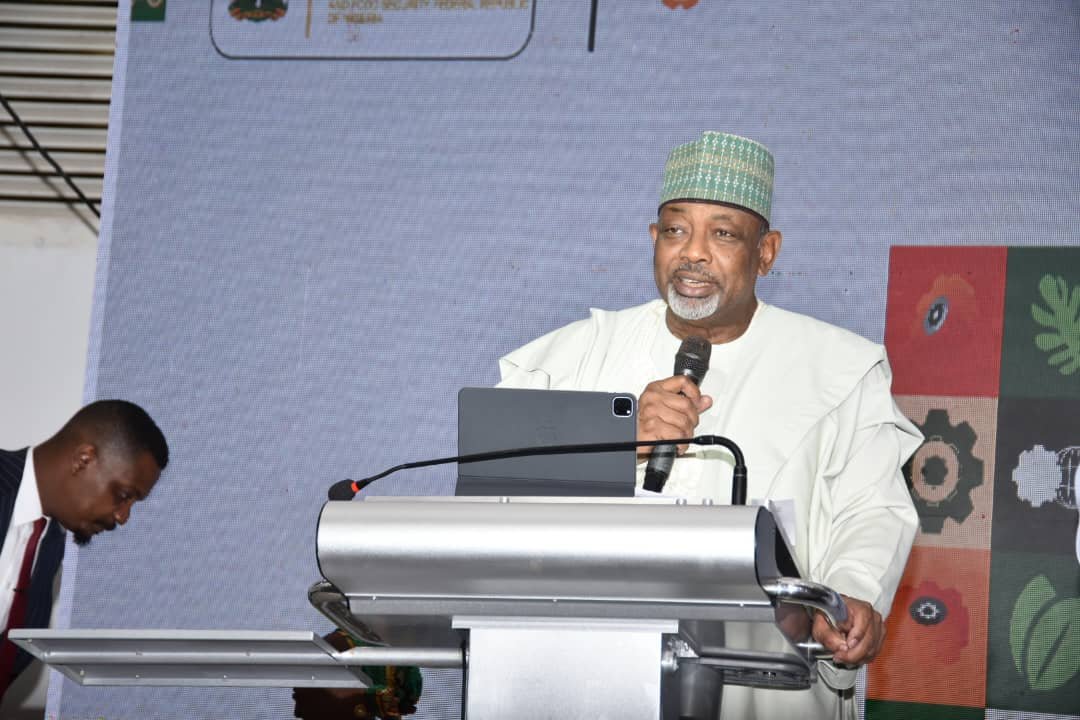
Speaking at the High-Level National Policy Dialogue on Agricultural Mechanization held in Abuja, on Wednesday 12th August, 2026, Minister of Agriculture and Food Security, Sen. Abubakar Kyari stated that the twin instruments provide the framework to move Nigeria “from agricultural potential to agricultural powerhouse; from mechanization deficit to mechanization leadership; and from food vulnerability to food sovereignty.”
“It takes more than land, more than good intentions to produce efficiently, competitively and sustainably to build our food systems. This is why today’s National Policy Dialogue is so important,” the Minister stated.
Senator Kyari said mechanization is not synonymous with tractors alone, but a full ecosystem covering land preparation, planting, irrigation, crop protection, harvesting, processing, storage, logistics, precision agriculture, digital technologies, financing, insurance, maintenance and after-sales services.
“Our ambition, therefore, must be larger than equipment ownership.
We must build a Mechanization-as-a-Service economy in which technology reaches the farmer when and where it is needed, at a cost that is commercially viable and sustainably financed.
This is the direction in which Government is moving,” he said.
According to him, under the Renewed Hope National Agricultural Mechanization Programme (RH-NAMP), the Federal Government has embarked on the procurement and ongoing deployment of 2,000 tractors and more than 9,000 assorted implements and spare parts — described as the largest single agricultural mechanization programme ever undertaken in Africa.
The Minister noted that the significance of the intervention lies not in the number of machines, but in whether they become productive economic assets that are maintained, financed, utilized and accessible to farmers.
He disclosed that the plant is aimed at reducing import dependence, localize production, create jobs, and build a sustainable mechanization economy.
Senator Kyari called on investors, youth and women to take ownership of the mechanization economy.
“Nigeria is open for investment in agricultural mechanization. We are not seeking capital merely to purchase machines. We are seeking partners to build an enduring agricultural technology and services ecosystem.”
“Agriculture is no longer a symbol of neglect. It has transitioned into a domain of enterprise, technology and wealth creation.
Our youths must not stand at the edge of the mechanization economy. They must own, operate, innovate and lead it,” he said.
The Minister cited Borno State as an example of state-level commitment, noting that His Excellency, Professor Babagana Umara Zulum_ has delivered 200 truckloads of fertilizer to farmers and unlocked7 more than a dozen solar-powered irrigation systems and sites to extend the farming season.
He also commended TracTrac MSL for training thousands of young Nigerians as mechanization service providers and deploying small-scale tractors to smallholder farmers.
“This is precisely the kind of private-sector enterprise that the Policy and the Investment Strategy are designed to multiply,” he added.
Sen. Kyari outlined a shared responsibility framework where the Federal Government will provide policy, standards and coordination, state governments will support with land access, infrastructure and implementation, the private sector will invest and deliver services, financial institutions will develop financing and risk-sharing instruments, while development partners and research institutions provide technical support.
He noted that the programme provides for the ratification of the National Agricultural Mechanization Policy and the inauguration of its Implementation Taskforce, marking the beginning of implementation.
In his remarks, the Executive Governor of Borno State, Prof Babagana Zulum lauded the Renewed Hope Agenda of President Bola Ahmed Tinubu’s in the agriculture sector which is geared towards achieving food sovereignty and economic growth.
Prof Zulum added that the Mechanization Programme of the Federal Ministry of Agriculture and Food Security would revolutionize the agricultural ecosystem.
While setting the tone for the Dialogue, the Minister of State for Agriculture and Food Security, Sen Dr Aliyu Sabi Abdullahi stated that Mechanization intitavtie would ensure that Nigeria Farmers have better livelihoods and boost Food production.
In his welcome address, the Permanent Secretary, Federal Ministry of Agriculture and Food Security, Dr. Marcus O. Ogunbiyi, FNSE, stated that Nigeria must be honest about the gaps that have held back agriculture for too long.
He noted that for years farmers have carried the burden of production with inadequate machinery, high levels of drudgery, limited access to appropriate technologies and insufficient investment across the value chain.
He stressed that agricultural mechanization is no longer simply about tractors and implements. According to him, it is about food security, productivity, rural prosperity, youth employment, women’s economic empowerment, private-sector investment and national competitiveness.