
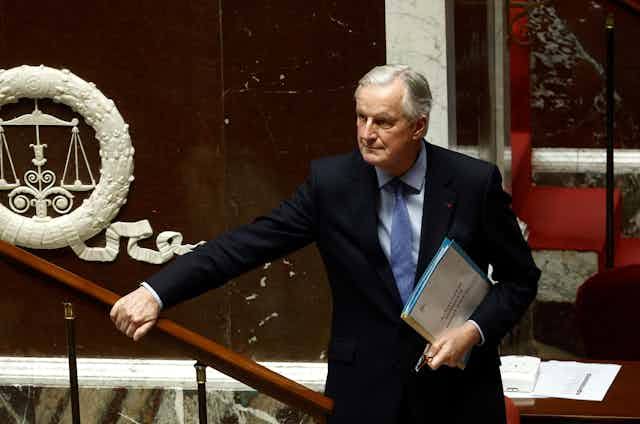
France’s parliament on Monday ousted the government of Prime Minister Francois Bayrou after just nine months in office, leaving President Emmanuel Macron scrambling to find a successor and plunging the country into a new political crisis.
Bayrou, who has been in the job for just nine months, had blindsided even his allies by calling a confidence vote to end a lengthy standoff over his austerity budget, which foresees almost 44 billion euros ($52 billion) of cost savings to reduce France’s debt pile.
Bayrou, the first premier in the history of modern France to be ousted in a confidence vote rather than a no-confidence vote, will submit his resignation on Tuesday morning, according to a person close to him who asked not to be named.
In the vote in the National Assembly, 364 deputies voted that they had no confidence in the government while just 194 gave it their confidence. “In line with article 50 of the constitution, the prime minister must submit the resignation of his government,” said speaker Yael Braun-Pivet.
Bayrou is the sixth prime minister under Macron since his 2017 election but the fifth since 2022. Bayrou’s ousting leaves the French head of state with a new domestic headache at a time when he is leading diplomatic efforts on the Ukraine war.
But defending his decision to call the high-risk confidence vote, Bayrou told the National Assembly: “The biggest risk was not to take one, to let things continue without anything changing… and have business as usual.”
People gather to celebrate after France’s prime minister failed to win a confidence vote in parliament, outside the City Hall (Hotel de Ville) of Nantes, western France, on September 8, 2025. (Photo by Sebastien Salom-Gomis / AFP)
Describing the debt pile as “life-threatening” for France, Bayrou said his government had put forward a plan so that the country could “in a few years’ time escape the inexorable tide of debt that is submerging it”.
“You have the power to overthrow the government” but not “to erase reality”, Bayrou told the MPs in a doomed final bid to save his government before the vote.
Unpopular president
Macron now faces one of the most critical decisions of his presidency — appoint a seventh prime minister to try to thrash out a compromise, or call snap elections in a bid to have a more accommodating parliament.
There is no guarantee an election would result in any improvement in the fortunes of Macron’s centre-right bloc in parliament.
And although the Socialist Party (PS) has expressed readiness to lead a new government, it is far from clear whether such an administration could survive.
Heavyweight right-wing cabinet ministers, such as Justice Minister Gerald Darmanin, are trusted by Macron but risk being voted out by the left.
According to a poll by Odoxa-Backbone for Le Figaro newspaper, 64 percent of the French want Macron to resign rather than name a new prime minister, a move he has ruled out.
He is forbidden from standing for a third term in 2027.
Around 77 percent of people do not approve of his work, Macron’s worst-ever such rating, according to an Ifop poll for the Ouest-France daily.