
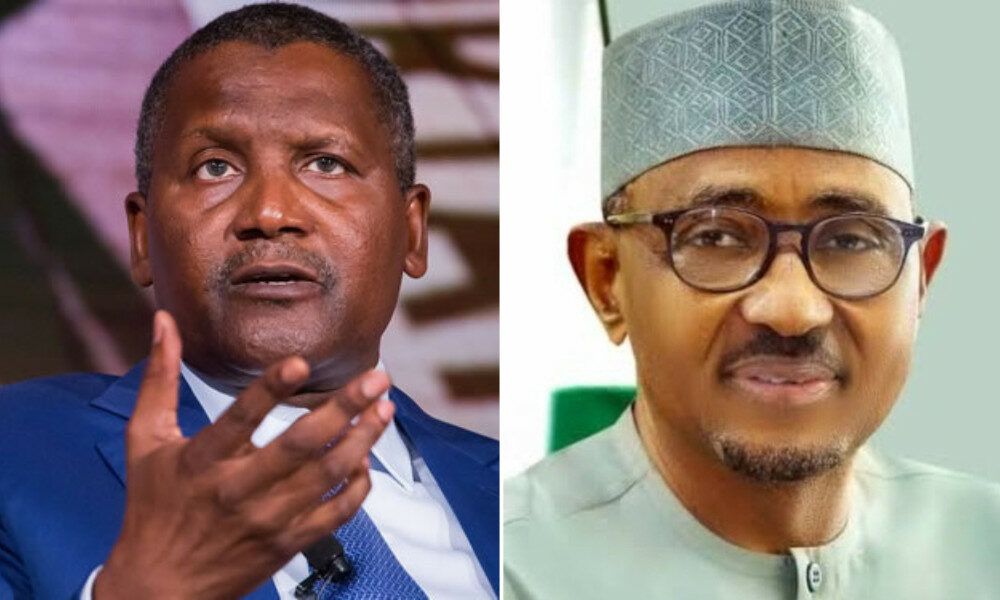
Chief Executive Officer of the Nigerian Midstream and Downstream Petroleum Regulatory Authority (NMDPRA), Engr. Farouk Ahmed, has issued a detailed public response to allegations linked to businessman Aliko Dangote, firmly denying claims of financial impropriety and formally inviting anti-corruption agencies to scrutinise his assets and transactions.
In a statement dated December 16, 2025, Ahmed described the allegations—particularly claims surrounding the funding of his children’s foreign education—as misleading and deliberately timed to coincide with regulatory decisions that have disrupted entrenched interests in Nigeria’s petroleum sector.
“Recent allegations regarding the financing of my children’s education have necessitated this response—not because I fear scrutiny of my finances, which I welcome—but because the timing and nature of these claims demand context that only three decades of public service can provide,” he said.
*Three Decades in the Petroleum Sector*
Ahmed traced his career back to 1991, when he joined the Department of Petroleum Resources through Nigeria’s competitive civil service examination, stressing that his rise was based on merit rather than political patronage.
He noted that he worked across technical divisions including crude oil marketing, gas supply monitoring and downstream operations—areas, he said, where decisions are guided by “engineering precision and market realities, not political expediency.”
By 2012, Ahmed had become General Manager of the Crude Oil Marketing Division, overseeing Nigeria’s most critical revenue stream during a volatile period in global oil markets. He later served as Deputy Director in 2015, a role he said exposed him to the political and commercial pressures surrounding fuel scarcity and pricing.
His appointment as NMDPRA Chief Executive in 2021, according to him, came with a clear mandate to implement the Petroleum Industry Act (PIA) reforms “with transparency and without favour.”
“Reforming a sector characterised by decades of opacity, preferential licensing and regulatory capture would necessarily antagonise entities whose business models depended on that very opacity,” Ahmed stated.
*On Children’s Education Funding*
Responding directly to claims that he spent about $5 million on his children’s Swiss education, Ahmed said the figure was inaccurate and misleading.
According to him, three of his four children received merit-based scholarships covering between 40 and 65 per cent of tuition, while additional funding came from education trust funds established by his late father, who died in 2018.
“When scholarships, family contributions and my own savings accumulated over three decades are properly accounted for, my personal financial obligation was entirely consistent with someone of my professional standing,” he said.
Ahmed disclosed that his annual compensation as NMDPRA CEO is about ₦48 million, inclusive of allowances, and that his finances are backed by decades of public service savings, cooperative investments and family resources.
“I have submitted detailed asset declarations to the Code of Conduct Bureau every year since entering public service,” he added, authorising educational institutions attended by his children to release financial records to Nigerian investigators.
Import Licences and Regulatory Independence
Ahmed also addressed criticism over NMDPRA’s fuel import licensing decisions, particularly claims that approvals issued in the first quarter of 2026 amounted to “economic sabotage.”
He dismissed the allegation, citing Section 7 of the Petroleum Industry Act, which mandates the regulator to ensure supply security and prevent scarcity.
“Granting import licences when domestic supply proves insufficient is not sabotage; it is our legal duty,” he said, warning that a single-source supply model, “regardless of ownership,” poses serious national risks.
He pointed to reforms introduced since 2021, including monthly supply reports, public data portals, depot-to-station fuel tracking and stricter quality controls, arguing that these measures have reduced fuel queues and eliminated long-standing inefficiencies.
“These reforms have naturally created friction with entities whose business models depended on regulatory opacity and preferential treatment,” Ahmed said.
*Calls for Full Investigation*
In a move he described as proof of confidence in his integrity, Ahmed formally requested investigations by the Code of Conduct Bureau, the Economic and Financial Crimes Commission (EFCC) and the National Assembly.
“I will cooperate fully, provide all documentation, and answer all questions under oath if required,” he said, adding that investigations must be professional and free from “predetermined conclusions driven by commercial interests.”
‘ *The Price of Principle’*
Ahmed concluded by stating that personal attacks would not deter him from carrying out his statutory duties.
“If the price of regulatory independence is personal attacks and manufactured scandals, I accept that price,” he declared.
“Integrity is tested not in comfortable moments but when powerful interests demand compromise. My record—financial and professional—will withstand any legitimate inquiry.”