
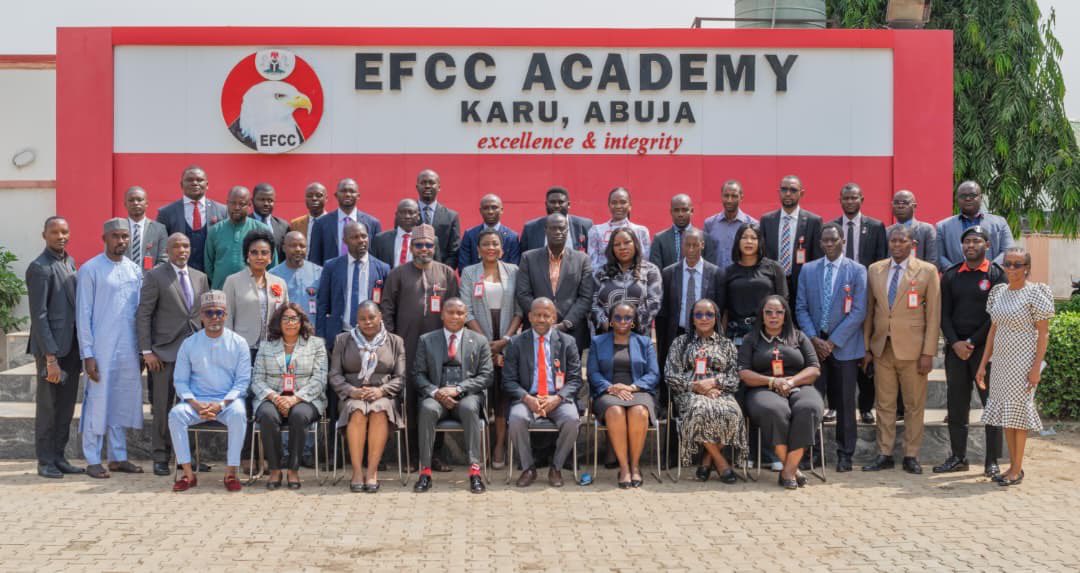
Executive Chairman of the Economic and Financial Crimes Commission (EFCC) Ola Olukoyede has applauded the Proceeds of Crime Act 2022 for its impact in asset recovery and management.
Speaking on Wednesday, March 4, 2026 at the opening ceremony of a workshop for officers of EFCC’s Department of Proceeds of Crime Management and other departments of the Commission at the EFCC Academy, Karu, Abuja, the EFCC’s Chairman noted that asset recovery and management was at the core of the Commission’s fight against corruption, economic and financial crimes, noting that the Proceeds of Crime Act 2022 “is a game-changer provided for a comprehensive legal framework for the identification, tracing, seizure, forfeiture, management, and disposal of proceeds of crime.”
The EFCC’s boss, who spoke through the Acting Commandant, EFCC Academy, Assistant Commander of EFCC, ACE1 Joseph Ogwiji, further observed that the Act has led to the “strengthening of financial intelligence and investigation, enhanced prosecutorial effectiveness, transparency and accountability in asset management and promotion of public trust in the anti-corruption framework.”
The Director, Department of Proceeds of Crime Management, Commander of EFCC, CE G.K. Latona in his remarks observed that the need for continuous knowledge sharing and capacity development of those saddled with the responsibilities of managing and disposing of recovered assets was imperative.
“The management, preservation and disposal of assets have now become a specialized issue and no longer a thing for the generalists. It has become professionalized worldwide that you now have associations like ARINWA, Asset Recovery Inter-Agency Network of West Africa. So, there is the need for us here to move along with this trend,” he said.
Obialunanma Nnaobi-Ayodele, Deputy Director, African Center for Governance, Asset Recovery and Sustainable Development, co-organizers of the workshop, stated that the collaboration with the EFCC was motivated by the Training Needs Assessment, conducted by her organisation with the of aim of mitigating money laundering and terrorist financing. She identified “strengthening legal competences, enhancing operational capability and fostering institutional collaboration with relevant agencies,” as the objectives of the training.
An interactive session at the Workshop brought out experiences and challenges peculiar to various commands of the EFCC and recommendations.