
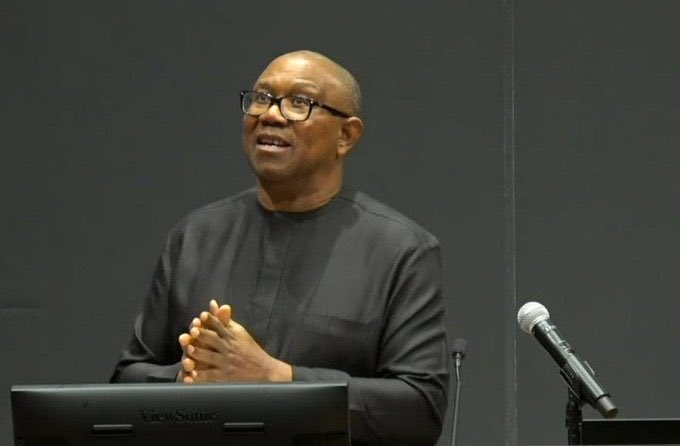
Former Labour Party presidential candidate, Peter Obi, has once again raised concerns over Nigeria’s electoral process, drawing a sharp comparison between the systems in India and Nigeria.
In a post shared on his official X (formerly Twitter) handle, Obi described the situation as a “Tale of Two Nations,” highlighting how India, despite its massive population, continues to conduct credible and efficient elections, while Nigeria still struggles.
He wrote: “India, the world’s largest democracy, with nearly 1 billion registered voters (over 960 million) and more than 60% actively participating in elections remains a model. The country has over 1 million polling stations and thousands of political parties, conducting elections using technology that enables electronic transmission of results within days, and operating a voter-friendly ballot system that displays party symbols and candidate photographs.”
Obi noted that India’s electoral structure and use of technology have helped build public trust and ensure speedy transmission of results.
In contrast, he lamented Nigeria’s ongoing challenges, despite having a far smaller voter population.
He stated: “By contrast, Nigeria, with only one-seventh of India’s population, has about 93 million registered voters, which is less than 10% of India’s voter base. With fewer than 20% of the polling stations and only about 1% of the political parties compared to India, it is deeply troubling that we still struggle to conduct elections, even when we record voter turnout below 20%.”
The former Anambra State governor further expressed disappointment over Nigeria’s inability to consistently organise credible polls.
“Sadly Nigeria still remains unable to consistently deliver free, fair, and credible elections or transmit results promptly, especially when compared to countries with far larger numbers than ours,” he added.
According to Obi, the root of the problem lies in leadership and governance priorities.
He explained: “The difference is leadership. In India, political leaders, legislators and judiciary work tirelessly for the welfare of their people and the future of their children, to do the right thing for the betterment of society, even amidst challenges.”
He contrasted this with what he described as policy failures in Nigeria.
“In Nigeria, many political figures instead implement policies that impoverish the people and threaten the future of our children,” he said.
Calling for a shift in political culture, Obi urged Nigerians to demand accountable and people-oriented leadership.
“If we are to transform Nigeria, we must demand leaders who put the people first, govern with integrity, and plan for a better tomorrow,” he wrote.
He concluded his message with his signature slogan: “A New Nigeria is POssible.”