
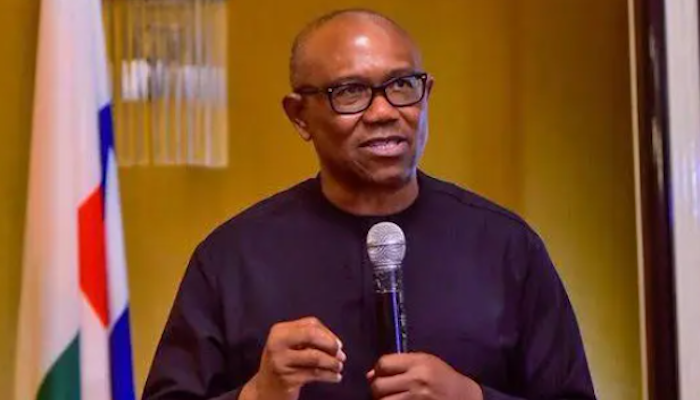
Former Labour Party presidential candidate, Peter Obi, has raised fresh concerns over Nigeria’s growing debt profile, warning that the country’s rising debt servicing obligations are beginning to overshadow investments in critical sectors such as education, healthcare, and poverty reduction.
In a statement shared on Monday on X following President Bola Ahmed Tinubu’s recent foreign tour, Obi argued that Nigeria’s fiscal priorities are becoming increasingly unsustainable, especially as debt repayments continue to consume a significant portion of national revenue.
According to him, President Tinubu disclosed that Nigeria would spend about $11.6 billion on debt servicing, a development Obi described as troubling for the country’s long-term economic future.
“During his recent foreign tour, President Bola Ahmed Tinubu stated that Nigeria will spend about $11.6 billion on debt servicing, a figure that should concern anyone interested in the country’s economic future and long-term development,” Obi stated.
While acknowledging that borrowing is not inherently negative, Obi stressed that debt only becomes beneficial when tied to productive sectors capable of generating economic growth and repayment capacity.
“There is nothing inherently wrong with borrowing when it is guided by prudence and directed toward productive investment,” he wrote.
Drawing comparisons with countries such as Japan, the United Kingdom, the United States, the United Arab Emirates, Singapore, and Indonesia, Obi noted that many advanced economies carry substantial debt burdens but channel borrowed funds into infrastructure, healthcare, education, and innovation.
“Countries such as Japan, the United Kingdom, the United States, the United Arab Emirates, Singapore, and Indonesia are all heavily indebted, yet their borrowings are largely channelled into education, healthcare, infrastructure, and innovation – sectors that generate long-term economic returns and sustain repayment capacity,” he said.
He, however, argued that Nigeria’s experience has been different, alleging that a large share of borrowed funds over the years has been spent on consumption rather than sustainable development.
“Nigeria’s situation, however, is markedly different. A huge proportion of past borrowing has been directed toward consumption, with limited visible or sustainable developmental outcomes to justify the scale of indebtedness,” Obi added.
The former Anambra governor further claimed that a significant portion of the debts currently being serviced were accumulated under the present administration, even as fresh borrowing continues.
He cited recent external loan arrangements, including about $5 billion from First Abu Dhabi Bank in the UAE, $1 billion through UK Export Finance via Citibank London, an additional $1.25 billion under consideration from the World Bank, and another $516 million arranged through Deutsche Bank.
According to Obi, the latest external borrowing commitments alone amount to nearly $7.8 billion, excluding ongoing domestic borrowing through monthly bond issuances.
He also questioned the disparity between debt servicing obligations and allocations to social sectors in the 2026 budget.
Obi noted that the proposed allocations for health, education, and poverty alleviation stand at ₦2.46 trillion, ₦2.56 trillion, and ₦865 billion respectively, bringing the combined total for the three sectors to about ₦5.885 trillion.
By comparison, he said debt servicing estimated at roughly ₦17 trillion to ₦18 trillion — depending on exchange rates — is almost three times higher than the total budgetary provisions for those sectors combined.
“This imbalance highlights a troubling fiscal reality in which debt obligations increasingly crowd out investment in human capital and poverty reduction,” Obi stated.
He further warned that even the limited allocations to the affected sectors may not fully translate into impact if releases are delayed or funds are mismanaged.
“Moreover, even within the limited allocations to these sectors, funds may not be fully released, and a significant portion of what is eventually released could be misappropriated,” he said.
Obi maintained that the real issue is not the act of borrowing itself, but whether borrowed funds are being transformed into measurable economic productivity and improved living conditions for Nigerians.
“Ultimately, the central issue is not borrowing itself, but whether borrowed funds are being converted into measurable productivity, inclusive growth, and improved living standards,” he stated.
“Without this, debt servicing shifts from being a temporary fiscal obligation to a long-term structural burden that constrains development and deepens economic vulnerability.”
He concluded the statement with his signature phrase: “A New Nigeria is POssible.”