
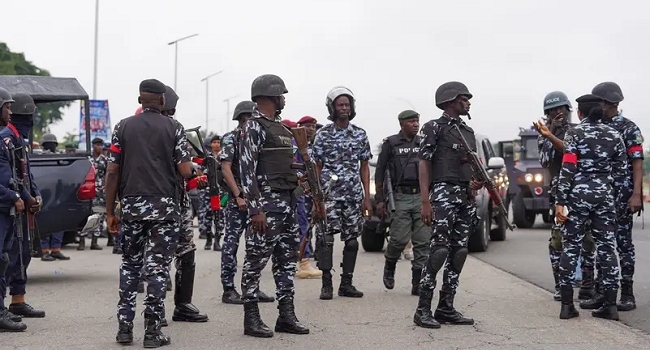
President Bola Tinubu is expected to take the next major step in Nigeria’s proposed policing reforms on September 3, when the draft national policing bill is scheduled to be presented to him for approval.
The Chief of Staff to the President, Femi Gbajabiamila, disclosed this on Monday while briefing journalists at the State House after a meeting of the Presidential Working Group on the National Policing Bill.
“The resulting executive bill package is scheduled for presentation to the President on the third of September. Subject to his approval, a national consultation on the completed draft will follow,” Gbajabiamila, who also chairs the Presidential Working Group, said.
“But I think that we have tweaked that so the national consultation will come before the President’s final approval, after which the text and supporting materials will be revised and prepared for formal transmission to the National Assembly,” Gbajabiamila said.
According to him, the approved work programme is a seven-week, milestone-driven exercise running from July 27 to September 14, 2026, with legal drafting, policy research, data analysis and implementation modelling taking place simultaneously.
He said the final package would go beyond a single bill and include schedules, an explanatory memorandum, a legal audit, a consequential amendments matrix, clause-by-clause analysis, a state readiness framework, a fiscal and implementation note, an implementation work plan, a validation report, a risk register and a controlled digital archive.
“These are the materials required to make the reform defensible, auditable and capable of implementation,” he said.
Gbajabiamila described the proposed reform as a landmark effort aimed at creating a policing system that responds more effectively to community realities while preserving national standards and constitutional safeguards.
“Now this is a monumental reform that Nigerians have debated over for many years. The question before the country is how we transform our policing architecture to become more responsive to the realities of our communities.
“Thus, our central task is now to design a lawful, professional, and sustainable federal and state policing system that places greater capability closer to the people while presenting national standards, national security, and the rights of every Nigerian.”
He noted that although the Senate approved the State Police Constitutional Proposal on June 24, 2026, and the House of Representatives passed the Executive State Police Bill on July 23, 2026, the constitutional amendment has not yet taken effect because it still requires approval from state Houses of Assembly.
Until that process is completed and implementing laws are enacted, he stressed, the Nigeria Police Force remains the country’s only constitutionally recognised police institution.
Gbajabiamila explained that while the constitutional amendment would provide the authority for federal and state policing, the National Policing Bill would address the operational framework covering standards, recruitment, training, funding, command structures, jurisdiction, complaints, firearms control, pensions, data systems and cooperation between federal and state police services.
He said President Tinubu constituted the Presidential Working Group to ensure Nigeria is fully prepared once the constitutional process is completed.
According to him, the group’s assignment includes producing an implementation-ready National Policing Bill, reviewing the Police Act 2020, the Police Service Commission framework and other laws affected by the proposed reform.
He said the Working Group brings together representatives of the Presidency, the Federal Ministry of Justice, the Office of the National Security Adviser, the Nigeria Police Force, the Nigerian Governors’ Forum and the Nigerian Bar Association, while a multidisciplinary policy advisory committee chaired by Justice Muhammad Liman will provide technical oversight.