
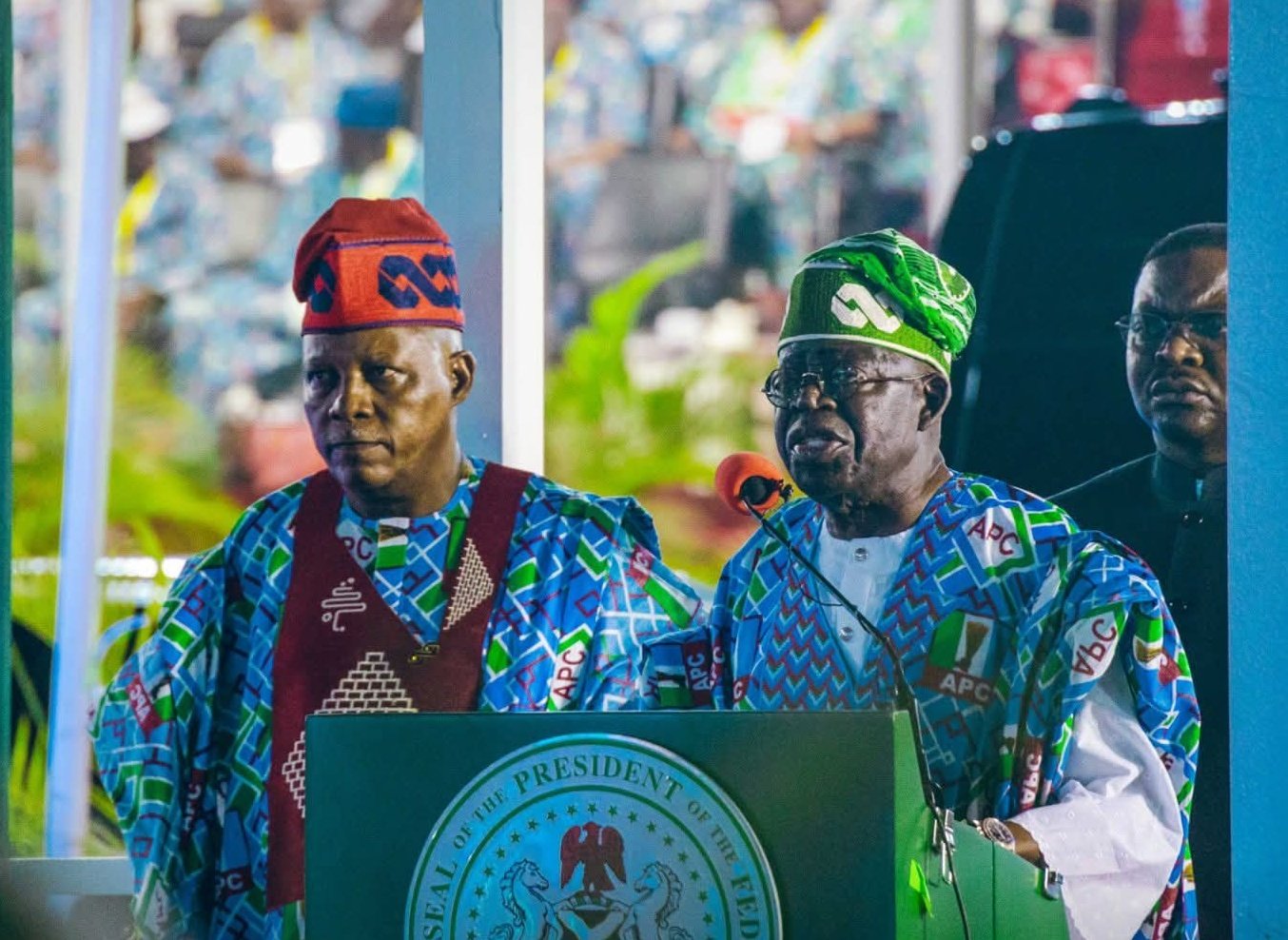
President Bola Ahmed Tinubu has attributed Nigeria’s current economic difficulties to global geopolitical tensions, including the ongoing conflict involving the United States, Israel and Iran, while defending his administration’s economic reforms as necessary steps toward long-term prosperity.
Speaking on Friday at the 4th Elective National Convention of the All Progressives Congress (APC) held at Eagles Square in Abuja, Tinubu said his administration had continued to make progress despite global economic shocks.
“Despite the complex global economic and political environment and the fact that we are currently experiencing another unanticipated blowout arising from the US-Israeli-Iranian War, we have made notable strides. We have made strides in infrastructure development, including the construction of superhighways and concrete-and-steel roads,” Tinubu stated.
His remarks come amid growing economic pressure on Nigerians, with rising costs of living and concerns over inflation and purchasing power.
Tinubu Defends Reforms Amid Hardship
The President acknowledged that reforms undertaken by his administration had required sacrifices but insisted they were necessary to reposition the economy.
“We knew the road to reform would be tough. We knew rebuilding Nigeria would require courage, patience, and difficult decisions. But we also knew: no nation rises by hiding from the truth. No economy grows by sustaining wasteful subsidies or dysfunctional priorities. No future is built on perpetual self-denial.”
He added, “The sacrifices of today are laying the foundation for Nigeria’s prosperity tomorrow.”
Tinubu said the government’s policies were already yielding results across key sectors, including infrastructure, fiscal reforms and social investments.
Tinubu Lists Economic Gains
Highlighting what he described as improving economic indicators, the President said Nigeria was experiencing renewed investor confidence and economic stability.
“Our stock market is booming, and listed companies are recording mega profits. Our GDP is growing. We have successively recorded trade surpluses. Inflation has declined steadily for eight consecutive months to 14.45%, while food prices are easing, bringing gradual relief to households. Business confidence is returning, with 12 consecutive months of economic activity expansion.”
Tinubu further noted that reforms in the oil and gas sector had improved foreign investment, while Nigeria’s Eurobond issuance attracted strong demand.
“Investor confidence has vastly improved. Our oil and gas sector has once more become attractive to foreign investment, following our reforms. Our Eurobond issuance was oversubscribed by 400%, and Nigeria exited the FATF Grey List, marking a decisive return to global financial credibility.”
Power Sector Challenges Remain
Despite the claims of economic progress, Tinubu admitted that the country still faces serious challenges in the power sector.
“Despite these achievements, we continue to face legacy issues such as electricity supply, debts to GENCOs and gas suppliers, and antiquated transmission infrastructure.”
To address the situation, the President announced the establishment of a new power infrastructure initiative.
“Recently, we announced plans to address this by establishing the Grid Asset Management Company (GAMCO), which will inject approximately 1,600 megawatts into a new grid corridor.”
Tinubu Urges Patience
The President insisted that the administration’s programmes were already making an impact and urged Nigerians to remain patient.
“Our programmes are real, visible, feasible, impactful, measurable, and not mere rhetoric, as some opposition elements like to say. We are moving from survival mode to stability and steadily towards an era of prosperity.”
Tinubu’s remarks formed a central part of his address to party leaders, governors, lawmakers and delegates at the APC convention, as the ruling party prepares to consolidate its political structure ahead of future electoral contests.