
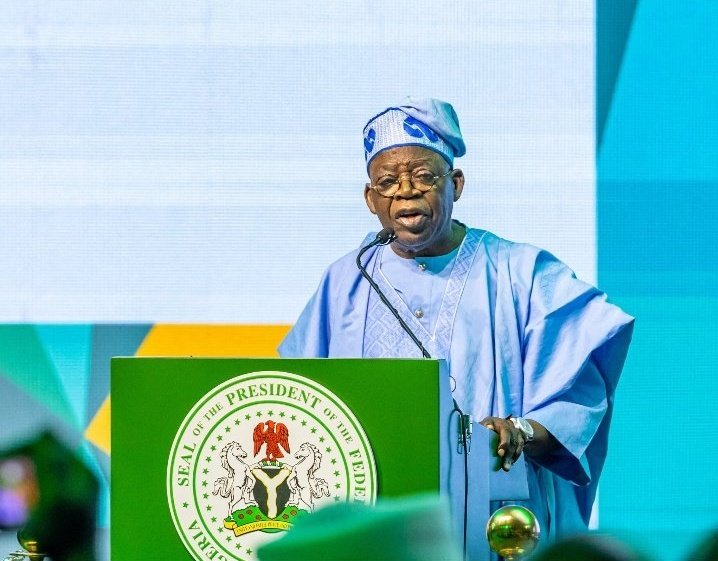
President Bola Ahmed Tinubu on Friday formally presented the 2026 Appropriation Bill to a joint session of the National Assembly, describing it as a decisive step to consolidate reforms, strengthen economic resilience and deliver tangible benefits to Nigerians.
Tagged “Budget of Consolidation, Renewed Resilience and Shared Prosperity,” the proposed ₦58.18 trillion budget reflects what the President called a transition from economic stabilisation to improved living standards for households across the country.
“I appear before this Joint Session of the National Assembly, in fulfilment of my constitutional duty, to present the 2026 Appropriation Bill of the Federal Republic of Nigeria,” Tinubu said at the start of his address.
Reform Gains Taking Shape
Tinubu acknowledged that the last two and a half years of reforms had not been easy, noting that families and businesses had faced pressure as long-standing structural weaknesses were confronted.
“These reforms were necessary — and they have not been painless,” he said. “I acknowledge these difficulties plainly, and I assure Nigerians that their sacrifices are not in vain.”
According to the President, early signs of recovery are now evident. He disclosed that Nigeria’s economy grew by 3.98 per cent in the third quarter of 2025, while inflation moderated for eight consecutive months, dropping to 14.45 per cent in November 2025 from 24.23 per cent in March.
“Our external reserves rose to a seven-year high of about $47 billion as at 14 November 2025,” Tinubu added, describing it as a stronger buffer against global shocks.
Budget Size and Fiscal Framework
The President outlined the major figures underpinning the proposal, with expected revenue of ₦34.33 trillion and projected expenditure of ₦58.18 trillion, including ₦15.52 trillion for debt servicing. Capital expenditure is set at ₦26.08 trillion, while the budget deficit stands at ₦23.85 trillion, representing 4.28 per cent of GDP.
“These numbers are not just accounting lines. They are a statement of national priorities,” Tinubu said, stressing the administration’s commitment to fiscal sustainability and value-for-money spending.
The budget assumptions include a crude oil benchmark of $64.85 per barrel, oil production of 1.84 million barrels per day, and an exchange rate of ₦1,400 to the dollar.
Focus on Security, People and Productivity
Security received the single largest allocation, with ₦5.41 trillion earmarked for defence and internal security. Tinubu said the funds would support modernisation of the armed forces, intelligence-driven policing, border surveillance and community-based peacebuilding.
“To secure our country, our priority will remain on increasing the fighting capability of our armed forces and other security agencies,” he said, adding that a new national counter-terrorism doctrine would fundamentally change how Nigeria confronts terrorism, banditry and kidnapping.
Under the new security architecture, Tinubu declared that any armed group operating outside state authority would be treated as terrorists. “The denominator is that if you wield lethal weapons and act outside the state’s authority, you are a terrorist,” he said.
Education and health also feature prominently, with ₦3.52 trillion allocated to education and ₦2.48 trillion to health. Tinubu disclosed that over 418,000 students have already benefited from the Nigerian Education Loan Fund, working with 229 tertiary institutions nationwide.
“In healthcare, investment is six per cent of total budget size, net of liabilities,” the President said, while also announcing over $500 million in grant funding from the United States for targeted health interventions.
Agriculture and Infrastructure Drive
Infrastructure will receive ₦3.56 trillion, alongside targeted investments in agriculture aimed at boosting food security, reducing post-harvest losses and improving incomes for farmers.
“Food security is national security,” Tinubu said, noting that the budget prioritises mechanisation, irrigation, storage, processing and agro-value chains to build a more diversified and resilient economy.
Stronger Discipline and Accountability
The President promised tighter discipline in budget implementation, directing key finance and budget officials to ensure strict adherence to timelines and appropriations. He also warned government-owned enterprises to meet their revenue targets, backed by end-to-end digital revenue systems to plug leakages.
“Nigeria can no longer afford leakages, inefficiencies, or underperformance in strategic agencies,” Tinubu said.
A National Compact
In his closing remarks, Tinubu described the proposal as “not a budget of promises,” but one designed to deliver results Nigerians can see and feel.
“With unity of purpose between the Executive and the Legislature — and with the resilience of the Nigerian people — we will deliver the full promise of the Renewed Hope Agenda,” he said as he laid the 2026 Appropriation Bill before the lawmakers.
“May God bless the Federal Republic of Nigeria.”