
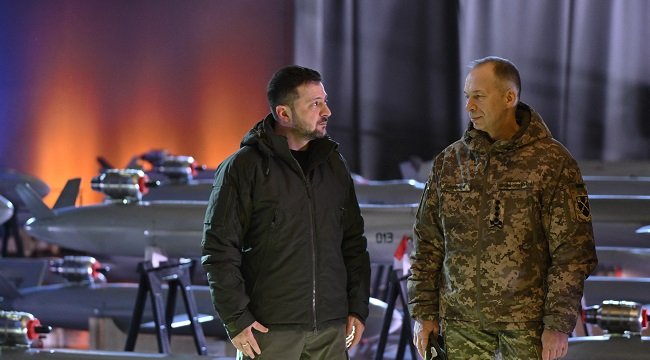
Ukrainian President Volodymyr Zelensky on Tuesday sacked his Soviet-trained army chief Oleksandr Syrsky following a political crisis triggered by the removal of a popular, young and tech-savvy defence minister.
The Ukrainian leader announced he was appointing joint forces commander Mykhailo Drapaty in his place.
Syrsky, 60, had served in the role since 2024 and was among Kyiv’s most experienced commanders, having led the defence of Kyiv at the start of Russia’s full-scale invasion in 2022.
His removal came after days of protests in support of ousted defence minister Mykhailo Fedorov, who accused Syrsky of forcing him out and stalling his attempt to reform the military.
“I have decided that the new Commander-in-Chief of the Armed Forces of Ukraine will be Mykhailo Drapaty,” Zelensky said in a post on Telegram.
“I am grateful to Oleksandr Syrsky and to each of our warriors for Ukraine’s strong frontline positions.”
Questions over Syrsky’s future came to the fore last week, when Zelensky removed highly-popular defence minister Fedorov just six months after appointing him.
Fedorov, a 35-year-old whose efforts to modernise the army brought him into conflict with its leadership, accused Syrsky of blocking his ideas and pressuring Zelensky to remove him — a charge Syrsky denied.
The row exposed rare divisions within Ukraine’s military and political leadership at a time when Kyiv appeared to be in its best position in the war for months.
Ukraine’s forces have slowed Russia’s advances to a crawl in recent months, while long-range Ukrainian strikes have struck Russian oil refineries that Kyiv says fuel the invasion.