
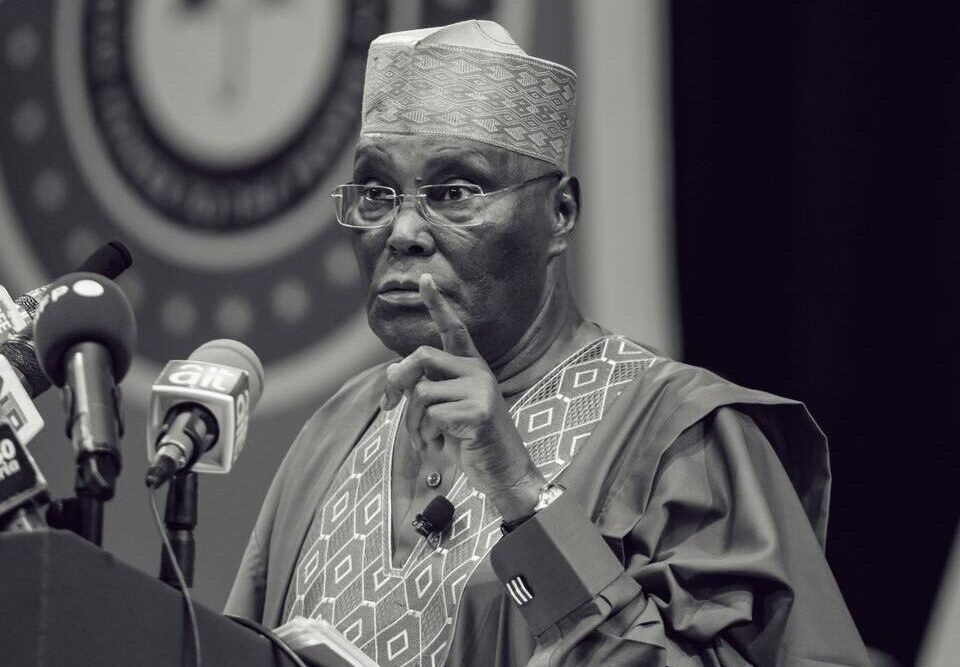
A media aide to former Vice President Atiku Abubakar, Paul Ibe, has defended his principal’s decision to reconsider his 2023 position on petrol subsidy removal, arguing that effective leadership requires the courage to review policies that inflict hardship on citizens.
Reacting to criticism from the Presidency, particularly Presidential spokesman Bayo Onanuga, Ibe said Atiku should not be condemned for changing his position after witnessing the impact of the policy on Nigerians.
Addressing Onanuga directly, Ibe wrote:
“Dear @aonanuga1956, H.E. @atiku should not be attacked simply because he is willing to reconsider a policy position he held in 2023. Leadership and heartlessness should never go together. A responsible leader must be prepared to rethink, restructure or even reverse a policy when its implementation is inflicting severe hardship on the people he seeks to govern.”
He acknowledged that Atiku had supported petrol subsidy removal during the 2023 presidential campaign but maintained that reviewing a policy after assessing its consequences should not be viewed as hypocrisy.
“Yes, Atiku supported removing petrol subsidy during the 2023 campaign. That fact should not be hidden. But changing one’s position after seeing the consequences of a particular implementation is not automatically hypocrisy.”
According to him, the real issue should be whether the subsidy removal has translated into improved living conditions for ordinary Nigerians through better transportation, healthcare, education, employment opportunities and social protection.
Citing reports by the World Bank, Ibe argued that the reforms had placed additional pressure on households through rising fuel prices and inflation.
He further stated that poverty levels had worsened despite signs of macroeconomic improvement.
“The evidence of hardship is difficult to dismiss. Since the 2023 reforms, the World Bank has acknowledged that subsidy removal and related reforms intensified pressures on households, with the removal initially contributing to sharply higher petrol prices and inflation.”
He added that millions more Nigerians had reportedly slipped below the poverty line while food insecurity remained widespread.
The Atiku aide rejected the argument that support for subsidy removal in 2023 meant the former vice president must continue backing the policy regardless of its outcome.
“Tinubu’s argument cannot simply be: Atiku supported subsidy removal in 2023, therefore he must support it forever. Public policy does not work that way. Governments evaluate outcomes. Economists revise assumptions. Central banks change course. Presidents should be capable of doing the same. When the human cost of a policy becomes intolerable such as Nigerians are currently experiencing under Tinubu, stubbornness is not leadership.”
Ibe also distinguished between recognising the shortcomings of the former subsidy regime and endorsing the current implementation of its removal.
He noted that even institutions that backed the reforms had emphasised the need for strong social protection measures to cushion vulnerable Nigerians.
According to him, many citizens continue to grapple with soaring transport fares, high food prices, increasing rents, school fees and declining purchasing power, while political leaders remain insulated from the daily realities faced by the public.
“President Tinubu and those around him may be insulated from the daily consequences of these policies, but millions of Nigerians are not. They confront transportation costs, food prices, rent, school fees and declining purchasing power every day. That disconnect is precisely why leadership requires empathy alongside economic theory. Nigerians should not be treated as expendable variables in an economic experiment.”
He insisted that a compassionate leader should be prepared to adjust policies when they no longer serve the interests of the people.
“I’d, therefore, rather have a leader who supported a policy, but having seen what its implementation has done to Nigerians, is prepared to reconsider it, than one who watches citizens sink deeper into hardship merely to avoid admitting that a policy needs restructuring.”
He added: “Policies are made for people. People are not made to suffer indefinitely for policies. When a policy is hurting the population it was supposed to serve, compassionate leadership demands the courage to rethink it.”
Highlighting Atiku’s proposed economic agenda, Ibe said the Atiku Economic Recovery Plan (AERP) would go beyond lowering fuel prices.
According to him, cheaper domestic refining would reduce the cost of petrol and diesel, lower transportation and logistics expenses, ease production costs for manufacturers and support businesses to expand and create jobs.
“The economic impact of the Atiku Economic Recovery Plan (AERP) will extend far beyond the filling station.”
He concluded by saying: “Lower domestic refining costs will reduce petrol and diesel prices, which will in turn reduce transportation and logistics costs across the economy; and enable farmers to spend less moving their produce to markets.
“Additionally, manufacturers will face lower production and distribution costs and businesses will have greater capacity to invest, employ and expand.
“Ultimately, the Atiku plan will jumpstart the economy laid prostrate by Tinubu’s ‘Bole Kaja’ policies!”