
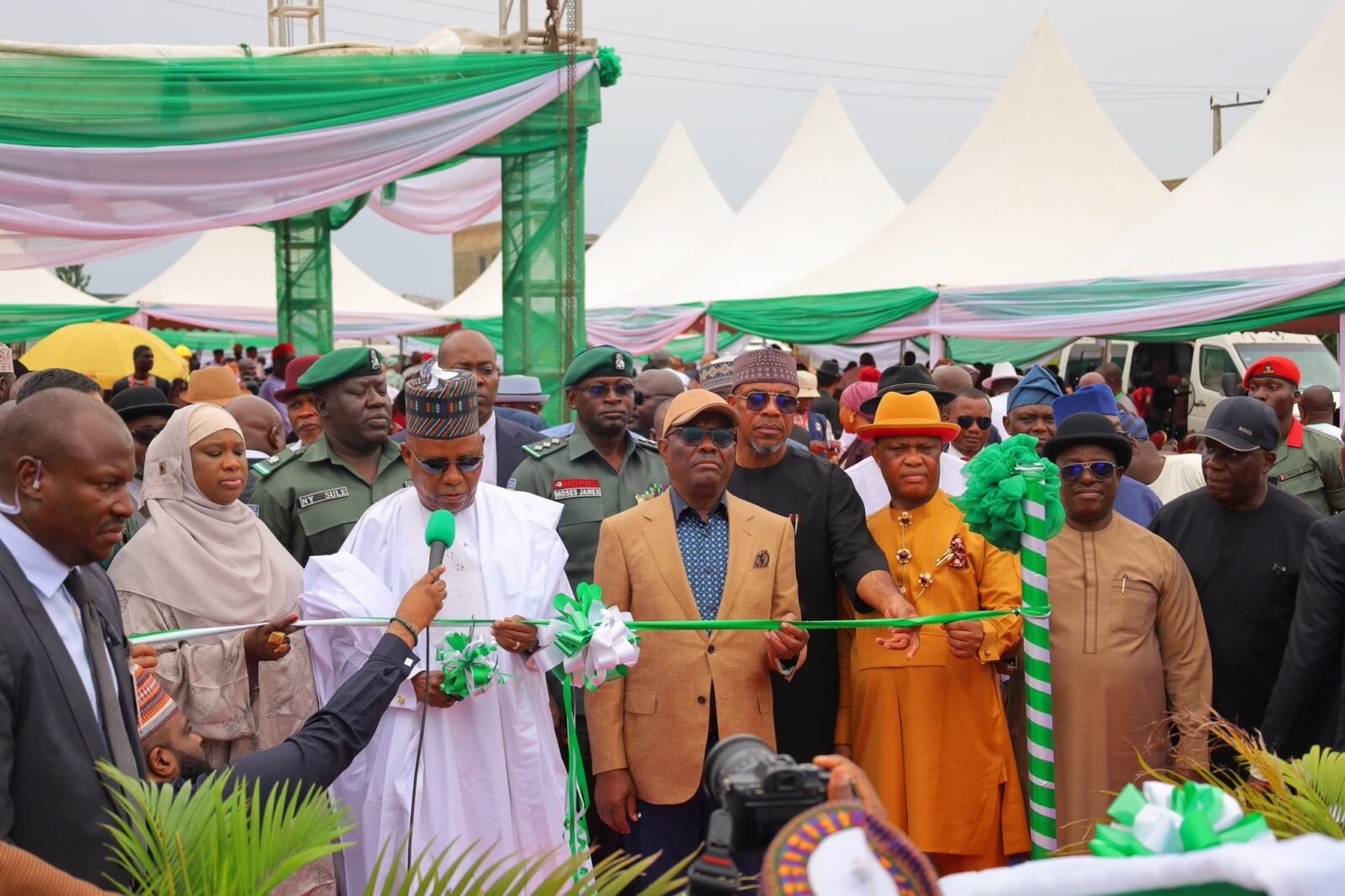
President Bola Ahmed Tinubu on Wednesday declared that the ongoing transformation of the Federal Capital Territory (FCT) is a reflection of his administration’s broader vision for Nigeria, promising sustained investments in cities, satellite towns and rural communities to deliver the dividends of good governance across the country.
The President made the declaration while commissioning Collector Road C01 and a bridge linking the Body of Benchers, Nile University and Baze University in Abuja’s Institution and Research District, describing the project as another fulfilled promise under the Renewed Hope Agenda.
Represented by Vice President Kashim Shettima, Tinubu said the completion of the road underscored his administration’s commitment to translating campaign promises into tangible projects.
“When we came into office, we made a solemn pledge to the Nigerian people. We promised not to allow governance to become a series of abandoned dreams and half-hearted efforts. We promised Renewed Hope.
“And today, as we stand on this newly constructed Collector Road C01, complete with its bridge, we are not just looking at the physical road; we are looking at a promise kept,” the President said.
He disclosed that the extension of the corridor toward RR III and other parts of Abuja had already been flagged off, adding that the project would integrate the Institution and Research District into the capital city’s wider road network.
According to him, the expanded connectivity will reduce travel time, eliminate traffic bottlenecks and strengthen links between educational institutions, residential communities and commercial centres.
“One road becomes a system. That is how connectivity scales,” he said.
Tinubu noted that the Institution and Research District was conceived in the Abuja Master Plan as the intellectual hub of the nation’s capital but had suffered years of infrastructure deficits that hampered access to key institutions, including the Body of Benchers, Nile University and Baze University.
Recalling complaints raised by the Body of Benchers during the Nigerian Law School Call to Bar ceremony last year, the President said his administration responded swiftly by approving the project through emergency procurement.
“When the Body of Benchers cried out to us during the Nigeria Law School Call to Bar ceremony last year for relief from traffic gridlock and lack of access, we listened.
“I told my Minister, the ‘Mr. Project’ of our time, Nyesom Wike, ‘We cannot have the legal luminaries of our nation navigating potholes to train our future advocates. We cannot have students arriving late to lectures because of a lack of a simple bridge.’
“We did not just talk about it. We approved it under emergency procurement. And today, just months later, here we are,” he said.
Tinubu said the project had restored ease of movement, improved safety and created a more conducive environment for academic and professional institutions to flourish.
He added that the construction had generated hundreds of direct and indirect jobs, describing infrastructure as a catalyst for economic growth.
“Infrastructure is the greatest enabler of economic prosperity. When you build roads, you open up districts. When you open up districts, you invite investment. And when investment comes, Nigeria grows,” he said.
The President commended the Minister of the Federal Capital Territory, Nyesom Wike, for what he described as his commitment to delivering projects across the territory.
“You have proven once again that when you are given a job, you do not sleep until it is done. This marathon of project commissioning across the FCT is a clear testament that this administration is firmly in action mode,” he said.
Tinubu urged the management, students and staff of Nile University and Baze University, as well as the Body of Benchers and residents of the district, to protect the infrastructure.