
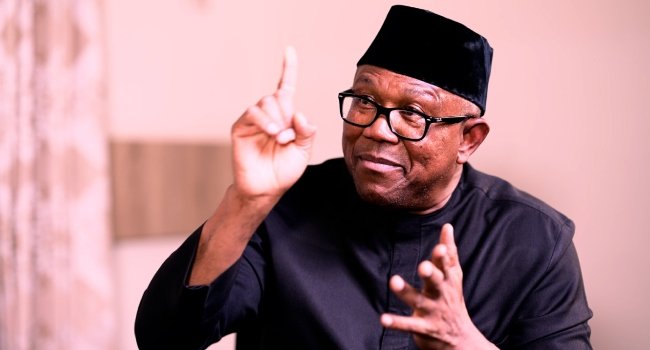
Nigeria Democratic CongresNDC) presidential candidate, Peter Obi, has criticised what he described as growing intolerance of criticism by the Federal Government, warning that attacking respected religious leaders instead of addressing Nigeria’s mounting challenges reflects a dangerous attitude toward truth.
In a post titled “When a Government Declares War on the Truth” shared on his X account, Obi expressed concern over the country’s worsening economic and security situation, arguing that those drawing attention to the realities facing Nigerians should not be vilified.
Obi wrote that, “President Donald Trump of America recently described Nigeria as ‘a now disgraced country.’ The painful reality is that Nigeria’s challenges continue to deepen. Each passing day reveals deeper signs of decline, especially when a government becomes increasingly intolerant of truth and hostile to those who speak about the suffering of the people.”
The former Anambra State governor defended the Catholic Bishops’ Conference of Nigeria (CBCN), saying the body has consistently served as a moral voice rather than a political opposition.
According to him, “The Catholic Church has never functioned as an opposition party in Nigeria. Across military regimes and successive democratic administrations, the Catholic Bishops’ Conference of Nigeria (CBCN) has maintained a principled voice on national issues and the nation’s conscience, commending governments when they deserved commendation and speaking the truth whenever national conscience demanded it.”
He added that the Church’s interventions are rooted in its commitment to truth, justice and the common good.
Obi also noted that other major religious organisations, including Jama’atu Nasril Islam (JNI), the Supreme Council for Shari’ah in Nigeria (SCSN), the Christian Association of Nigeria (CAN), and the Nigerian Supreme Council for Islamic Affairs (NSCIA), have similarly voiced concerns over hardship, insecurity and inflation.
According to him, religious leaders speak out because they interact directly with ordinary Nigerians and witness the impact of rising food prices, unemployment and insecurity on families.
Drawing from his experience as governor of Anambra State, Obi said constructive criticism from traditional rulers and religious leaders contributed to the success of his administration.
“As leaders, we should be gracious enough to listen to people and organisations that speak the truth to us and genuinely criticise us when things are not going in the right direction,” he said.
He added, “As Governor, I had the opportunity of working with a very strong Council of Traditional Rulers, led by the Obi of Onitsha, and religious bodies that consistently criticised me and offered suggestions. This contributed greatly to our success in Anambra State, especially in critical areas like education and health.”
Obi described the recent attacks on the CBCN and Cardinal John Onaiyekan as unfortunate, recalling that even during the military era, religious leaders who criticised government policies were not subjected to similar treatment.
He said, “Against this background, the attacks on the CBCN, and especially on His Eminence, John Cardinal Onaiyekan, are deeply troubling. Even in 1998, when Pope John Paul II visited Nigeria and told General Abacha some hard truths, including about the incarceration of Chief Moshood Abiola, nobody vilified him.”
The former presidential candidate also referenced President Bola Tinubu’s attendance at the inauguration of Pope Leo XIV in Rome, arguing that the President had publicly demonstrated respect for the Catholic Church during the event.
According to Obi, “Back in Nigeria, however, that posture has now changed completely.”
He further accused some presidential aides of attempting to portray the criticism by Catholic bishops as a religious issue instead of addressing the substance of their concerns.
Obi questioned whether insecurity, poverty, inflation and unemployment were problems limited to any particular religion or ethnic group.
He maintained that the bishops merely echoed the daily realities confronting millions of Nigerians, including worsening insecurity, rising poverty, struggling businesses and declining hope.
Rather than responding with attacks, Obi urged the government to focus on addressing the issues raised and implementing measures that would improve the living conditions of Nigerians.